Build, Buy, or Hybrid?
This is the chapter most owner organisations want to skip to first.
That is the mistake. The decision is consequential for a decade. It commits the organisation to a particular cost profile, risk exposure, and operating identity. Build commits you to creating a permanent capability with multi-year payback. Buy commits you to ongoing external dependency with no internal residue unless you explicitly design for it. Hybrid attempts to capture the strengths of both while accepting the complexity of operating in two modes simultaneously. The decision is also reversible only at substantial cost — an organisation that builds and later abandons internal capability writes off years of investment, and an organisation that buys and later attempts to build faces the same multi-year build challenge with the added burden of disentangling from partner dependencies.
Decisions of this magnitude should be made on evidence, not on preference. Which is why this chapter has to come after Chapter 1.
Build: develop the capability internally
Under the Build scenario, the organisation develops a permanent in-house project management function. Leadership recruited, framework adopted, tooling implemented, processes documented, governance established, and culture developed. The organisation retains accountability for delivery and for capability simultaneously.
Typical investment for a function capable of delivering a major programme is in the order of £2–4 million over three years. The investment is multi-year and front-loaded — most of the cost is incurred before the function can credibly deliver. Funding must be committed across multiple budget cycles. In my experience, the single most common cause of capability builds being abandoned in year two is annual budget reapproval: the executive sponsor leaves, the new one has different priorities, and the build evaporates before it has delivered anything visible. Build the multi-year commitment in at the start, or do not start.
Build delivers long-term value through retained capability. It integrates project discipline culturally. It reduces ongoing reliance on external providers and lowers lifetime cost for organisations with a genuine recurring programme pipeline. The risks are real: 24 to 36 months minimum to credible capability, high people dependency in the early years, recruitment failure (the right person may not be available at the right time), and — the most underestimated risk on this path — cultural change. The function may be established, but the surrounding organisation may not adapt to give it operating space. A PM function that exists on the organogram but cannot actually challenge engineering, procurement, or finance is not a PM function. It is a reporting team.
Buy: procure the capability from the market
Under the Buy scenario, the organisation procures programme management capability from an external delivery partner under a defined contract, retaining a minimum intelligent client function internally. The internal organisation provides sponsorship, governance, and final accountability. The operational PM work is conducted by the partner.
The contract design becomes the primary control mechanism. Procurement, evaluation, contract administration, and partner performance management are the critical client-side activities.
The market is mature. There are established providers across consulting, engineering, and specialist PM firms. Quality varies materially — selection on track record matters more than brand. The things to watch for: depth of programmes at scale in the relevant sector, retention of named individuals across the engagement, and conflict-of-interest separation from any other commercial relationships with the same client. The company that won the contract may not be the team that delivers it; the bid team and the delivery team are not always the same people, and contracts that don’t name key individuals leave that to chance.
Costs are higher per unit but there is no upfront capability investment. Fees are typically 8 to 12 per cent of programme value for full-service PM engagements at this scale, with significant variation by sector, complexity, and contractual form. The cost profile is variable — aligned with programme spend rather than carried as ongoing organisational overhead. This makes Buy economically attractive for episodic delivery and economically inefficient for recurring delivery.
Here is the trap I see most often on this path. Buying capability does not eliminate the need for internal capability. The intelligent client function — senior sponsor, commercial literacy, technical capability, performance interrogation, board governance — must exist regardless of who delivers. Most Buy-path failures stem from underestimating this requirement and treating procurement of external capability as a substitute for internal development. The organisation that procures fully and invests nothing internally has not bought capability. It has bought dependency.
Hybrid: combine the two, on a sequence
For most low-maturity owner organisations facing a single near-term major programme with the prospect of more to follow, the Hybrid path is the one I recommend. It combines the rapid capability access of Buy with the durable internal capability development of Build, sequenced so that each enables the other.
Three components, in sequence. First, procure experienced programme leadership for the immediate programme on an interim or fixed-term basis. Second, build the intelligent client function from day one as a permanent internal investment. Third, use the programme as the capability development vehicle for an internal nucleus that will inherit delivery responsibility for future programmes.
Each component reinforces the others. External leadership delivers the programme while developing the internal team. The intelligent client function provides governance throughout and survives any transition. The programme itself is the deliberate training environment. The chapter on Design will go into how to specify the transition; for now, the principle is that Hybrid is not “a bit of Build and a bit of Buy.” It is a sequenced model with explicit triggers for moving from one mode to the next.
Hybrid is appropriate when the diagnostic shows a recurring or committed future programme pipeline, low current maturity that cannot be built quickly enough for the immediate programme, sufficient time horizon to allow capability transfer (typically three to five years), strategic intent to internalise eventually, and willingness to invest in both procurement and recruitment in parallel.
Hybrid is inappropriate when the pipeline is genuinely one-off (Build is wasteful), when leadership readiness is too weak to sponsor any internal capability development (the diagnostic itself becomes the recommendation), or when the organisation lacks the financial commitment to invest in parallel external and internal capability.
The comparison
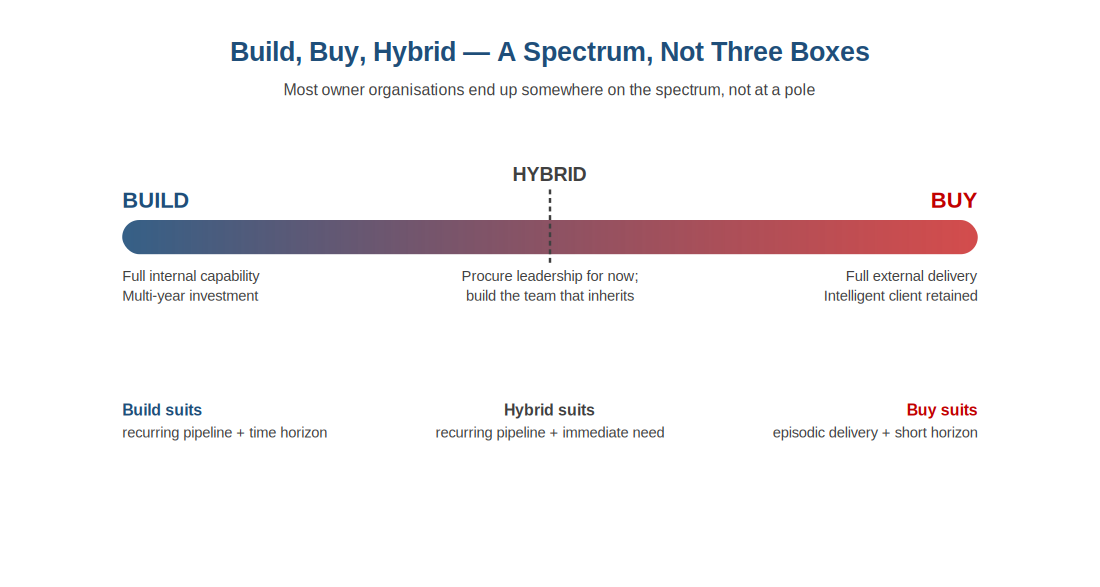
The three modes look like distinct boxes when laid out on a slide. In practice, most owner organisations end up somewhere on the spectrum, not at a pole. The strongest decisions are those that recognise this from the outset rather than discovering it through trial and error.
As a quick summary, here is how the three sit against the dimensions that most commonly drive the decision.
| Dimension | Build | Buy | Hybrid |
|---|---|---|---|
| Time to capability | 24–36 months | Immediate | 12–18 months |
| Upfront investment | High | Low | Medium |
| Ongoing cost | Fixed overhead | 8–12% of spend | Hybrid |
| Capability retention | Full | None unless designed | Partial, growing |
| Vendor dependency | None | High | Reducing over time |
| Suits recurring pipeline | Yes | No | Yes, with transition |
| Suits episodic delivery | No | Yes | Requires care |
The pattern that emerges is consistent. Build suits organisations with recurring pipeline and time horizon. Buy suits organisations with episodic delivery and short horizon. Hybrid suits organisations with recurring pipeline but insufficient current capability to execute the immediate programme internally.
What not to do
A short list, in increasing order of damage.
Do not procure full external delivery without an intelligent client function. The procurement will not buy what the organisation needs to govern the work.
Do not build internally without sponsor commitment and multi-year funding. The build will collapse in year two if this is not in place.
Do not hybridise without explicit transition triggers. The hybrid will become permanent by default and the capability transfer will not occur.
Do not delay the decision in the hope that conditions will clarify. Decision deferral is itself a decision, and almost always the wrong one for major programmes with committed timelines.
How the decision is made
The decision should be made by the board, on evidence from the Stage 1 diagnostic, advised by an independent specialist who has no commercial interest in the outcome. An adviser whose firm may later be engaged to deliver the chosen scenario is not an independent adviser. That sentence is repeated in this book for a reason.
The decision should be documented formally, with the rationale stated and the diagnostic evidence cited. This ensures future revisits have a baseline to test against. A decision recorded only as a board resolution but not as a documented analysis cannot be re-examined later because the original conditions are not visible.
And the decision should be reviewed at programme gateways and at least every 18 to 24 months. Continuous re-examination is destabilising; scheduled re-examination is essential. This is what closes the methodology loop: every Sustain stage (Chapter 5) carries the trigger to re-run this decision against current conditions.
• • •