Where do you actually stand?
Ask any owner organisation if it is ready to deliver a major programme, and it will tell you yes.
Not because it is lying. Because it genuinely believes it.
This is the trap at the heart of the methodology, and it is worth understanding why it happens before we look at how to escape it.
An organisation cannot see what it has never had. A board that has never sponsored a £100 million programme cannot accurately judge whether it is ready to sponsor one, because it has no reference point. It is assessing itself against a standard it has never experienced. A project function that has only ever delivered £5 million projects cannot reliably estimate what a £100 million programme demands. The gap is not twenty times bigger. It is different in kind — different governance, different commercial exposure, different failure modes.
This is why self-assessment consistently produces optimism. It is not a character flaw. It is a structural blind spot.
It is also why honest diagnosis has to be independent. Someone outside the organisation, with no stake in the answer, comparing what they observe against what major programme delivery actually requires — not against what the organisation is used to. The diagnostic is not a maturity audit and it is not a single number. It is a structured picture of capability, intent, and risk across five domains. The output is a shape, not a score.
The five readiness domains
When I diagnose an organisation, I look at five domains. They are not the only things that matter, but they are the ones that, in my experience, determine whether an owner organisation can credibly govern and deliver a major programme.
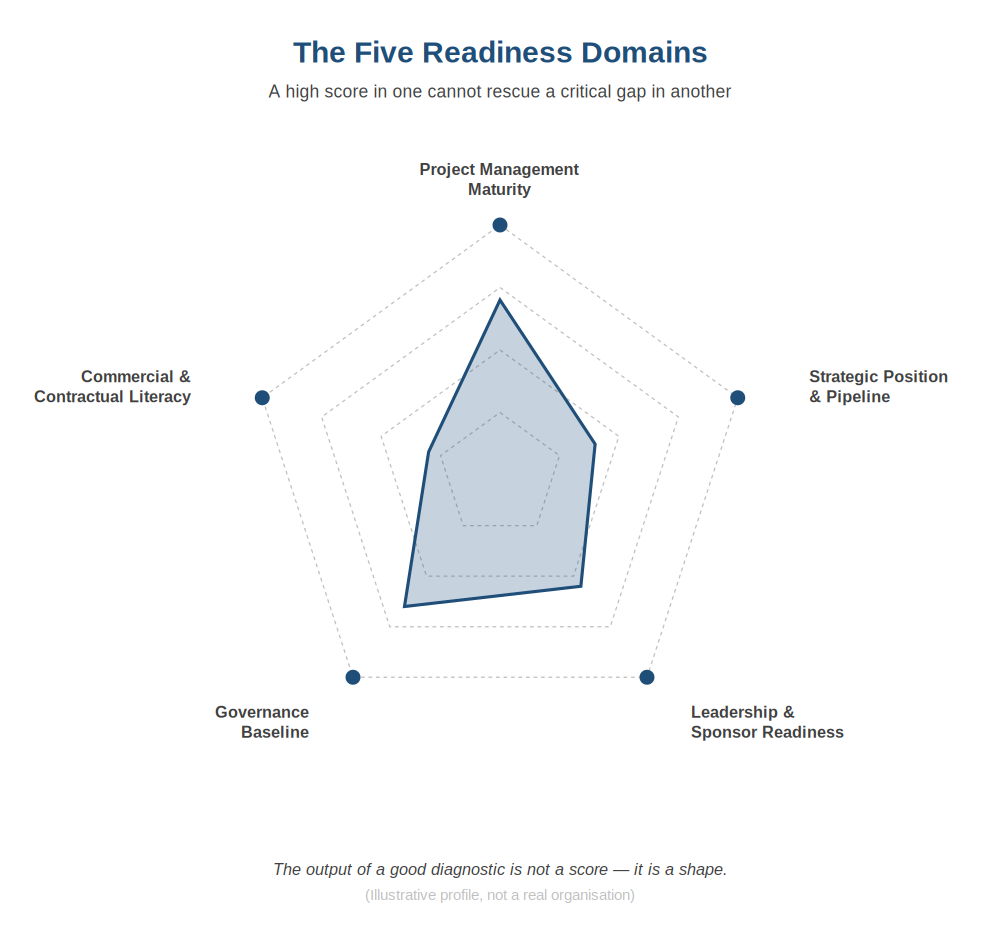
Here is the important part: these five domains interact. A high score in one cannot rescue a critical gap in another. Strong governance with weak commercial literacy is not “mostly fine.” It is a specific, predictable vulnerability. Strong leadership with no genuine pipeline is a recipe for a permanent capability investment that the organisation cannot justify and will not sustain. The shape is the finding. Let me walk through each domain.
1. Project Management Maturity
This is the domain everyone expects to be assessed. People, process, tools, governance, culture — the capability already in the building. Most organisations, asked to rate their own PM maturity, land somewhere around “we’re pretty good.” They point to their project framework, their scheduling software, their PMO.
Here is what I have learned to look at first, and it is none of those things.
Culture. Specifically: what actually happens in your organisation when a project runs into trouble?
Every organisation believes its culture supports honest reporting. Very few have actually tested that belief, because the test only happens when there is bad news to deliver, and at programme scale that test has not been run yet. So I look at the smaller signals. How did the board respond to the last project that slipped? When a project manager escalated a risk early, what happened to them? Are the status reports across the portfolio suspiciously, uniformly green?
A portfolio where every project is green is not a well-run portfolio. It is a reporting culture that has learned not to deliver bad news. You can have an excellent framework, modern tools, and a fully staffed PMO — and still fail, because the culture punishes the early warning that would have saved you. Process and tools are visible and easy to assess. Culture is neither. It is also the one that decides whether the rest of it works.
2. Strategic Position and Pipeline
This domain answers one question that shapes everything downstream: is this major programme a one-off, or the first of several?
It matters enormously. Building permanent in-house delivery capability is a multi-year, multi-million-pound investment. It makes sense if the organisation has a genuine pipeline of major programmes ahead of it. It is waste if this programme is a single event.
So I ask to see the pipeline. And here is what I usually find. There is a gap — often a wide one — between strategic intent and committed pipeline. Boards describe an ambitious forward programme: “we have a decade of major investment ahead.” But when you examine it, much of that pipeline has no committed funding, no board-approved business cases, and a history of slipping in every previous planning cycle. A pipeline that is real on a strategy slide is not the same as a pipeline that is real in the capital budget.
This is not dishonesty. Strategic ambition is the board’s job. But ambition is not commitment, and you cannot justify a permanent capability investment on ambition. The test I apply is simple: how much of the stated ten-year pipeline has actually been through an investment decision? If it is most of it, the pipeline is real. If it is a fraction, the organisation has one programme and a wish list. That distinction changes the entire downstream answer.
3. Leadership and Sponsor Readiness
This is the most uncomfortable domain to assess. It is also the most consequential, and the one organisations most want to skip past.
It comes down to two questions.
First: is there a credible senior sponsor — with real authority, real programme experience, and real time? The time part is where it usually breaks. Boards routinely expect an executive to sponsor a major programme on top of an already-full role. But sponsoring a major programme properly is not a calendar add-on. It is, realistically, at least a day a week of genuine engagement. A sponsor in name who is unavailable in practice is one of the most reliable predictors of programme trouble I know.
Second: does the board actually want honest reporting? Every board says yes. The evidence is in the behaviour. How did they respond the last time an executive brought them genuinely bad news about a major activity? Was it met with “thank you for telling us early, what do we do” — or with a search for someone to blame?
Boards get the reporting culture they reward. If early bad news is punished, even subtly, the organisation learns to stop delivering it. And then the board is governing on information it cannot trust. Leadership readiness cannot be assessed from a document. It is assessed from behaviour — from how leaders have actually acted when delivery was hard. Past behaviour predicts future behaviour far more reliably than stated intent.
4. Governance Baseline
Most organisations heading into a major programme already have governance. Boards, committees, delegations, reporting cycles. It works. The business runs. So the assumption is natural: we have governance, we will govern the programme with it.
That assumption is wrong, and it is an expensive one.
Governance built for operations is not governance built for major programmes. They are different instruments for different jobs. Operational governance manages a steady state — known activities, predictable cycles, incremental decisions. It is built for continuity. Programme governance manages a large, time-bound, high-uncertainty endeavour. It needs different decision rights, faster escalation routes, explicit investment gates that can actually stop the programme, a defined risk appetite, and board reporting designed for a programme’s rhythm rather than the business’s.
When I assess this domain, I am comparing what exists against what major programme delivery specifically requires. The gap is usually large — and the organisation usually has not noticed it, because their operational governance genuinely works and they have no reason to suspect it will not transfer. The most common symptom I see: a major programme reporting into a monthly operational meeting, getting fifteen minutes between the management accounts and the health-and-safety update. A nine-figure programme cannot be governed in fifteen minutes a month.
5. Commercial and Contractual Literacy
This is the domain organisations most often overlook, and the one most directly tied to financial exposure. It is where the largest hidden weakness usually sits.
Here is the distinction that matters, and that most organisations miss: procurement capability and contract administration capability are not the same thing.
Plenty of organisations are good at procurement. They can run a competitive process, evaluate bids, select a partner, sign a contract. The day the contract is signed, they consider the commercial job done. It has barely started. A major programme contract — NEC4, FIDIC, bespoke — is a living instrument. It has to be administered: change managed rigorously, claims anticipated and assessed, commercial reporting interrogated rather than accepted, the organisation’s position defended when it should be and conceded when it should be. That is a different skill from procurement. It needs different people, doing it continuously, for the life of the programme.
When I assess this domain, I look at how recent contracts were actually administered. Were changes controlled, or waved through? Were claims managed, or settled to make them go away? Can anyone in the organisation read a contractor’s commercial report and challenge it with authority? An organisation that can procure a major contract but cannot administer it has not bought delivery. It has bought exposure. This is also where the intelligent client function lives — the internal capability that holds the organisation’s commercial interests, whoever is delivering the work. I’ll return to it in Chapter 3.
What the diagnostic produces
I present findings as a heatmap. One page across the five domains and their sub-dimensions, with a narrative report behind it.
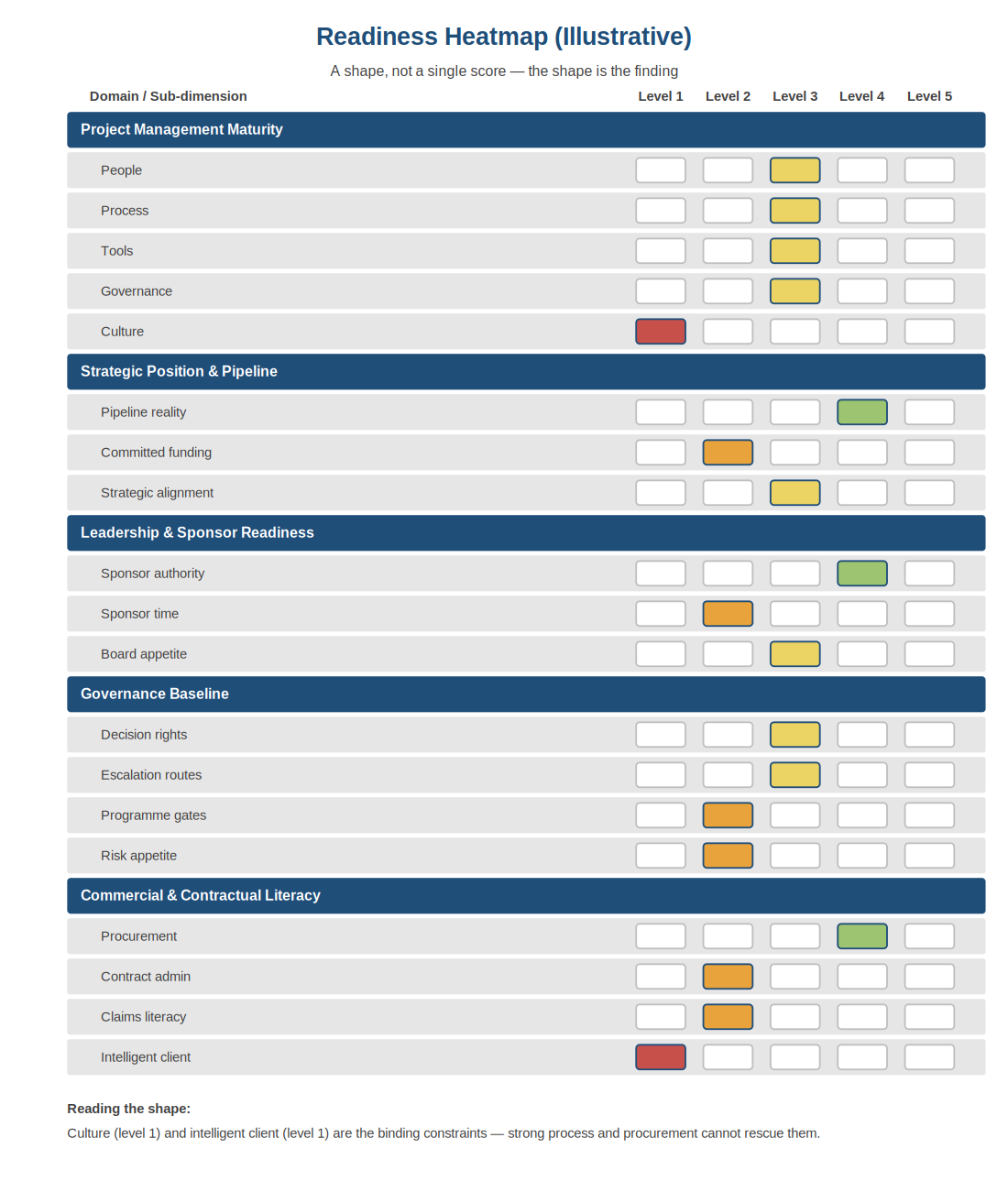
The heatmap is deliberately not reducible to a single composite score. The shape of capability across domains is the finding, not an average. A board reviewing it should be able to see at a glance where the organisation is strong, where it is weak, and where the gaps interact to amplify risk. The narrative report explains the heatmap, evidences each finding with the source observations from interviews and document review, and offers prioritised recommendations sequenced by criticality. It is written to be read by board members, not just by the programme team.
The five organisations I keep meeting
After enough readiness diagnostics, you stop seeing five separate organisations and start seeing the same handful of patterns, over and over.
The governance-rich, culture-poor organisation. Impressive governance on paper — committees, frameworks, reporting. But underneath, a culture that does not escalate early and does not welcome bad news. Strong structure, weak nervous system.
The technically credible, commercially exposed organisation. Excellent engineering. Real delivery pride. But weak contract administration and weaker commercial reporting. They can build the thing. They cannot defend their position when the contract is tested.
The willing-but-unready leadership. A genuinely committed sponsor and an engaged board, who simply have not operationalised that commitment. The intent is real. The time, the authority, the behaviours are not yet in place.
The procurement-heavy, administration-light organisation. Skilled at letting contracts, weak at managing them once let. The commercial effort peaks at signature and falls away exactly when it should be ramping up.
The aspirational-pipeline organisation. A confident ten-year investment story with very little committed funding behind it. One real programme, presented as a portfolio.
None of these patterns is fatal. Each is specific, predictable, and addressable — if it is identified before the programme starts rather than discovered halfway through. The diagnosis is not there to produce a grade. It is there to tell you which of these you are, so you can act.
How the diagnostic is run
Practically: four to six weeks from engagement to final report. Independent assessor with no commercial interest in the answer (and no firm waiting in the wings to deliver whatever the recommendation turns out to be). Inputs include document review of governance papers, project documentation, and board minutes; structured interviews across the leadership team and the intended programme roles; observation of live governance meetings where possible; and a workshop-based validation session before the findings are finalised.
Deliverables are a written report with the heatmap and narrative findings, a board presentation, and a private debrief with the sponsor for observations best discussed off the record. The board owns the findings; the assessor’s role ends at delivery and any follow-up engagement is separately scoped.
This is not an audit, not a performance review of individuals, and not a procurement exercise. It is a snapshot of readiness intended to inform a strategic decision, taken once and revisited as the organisation evolves.
• • •